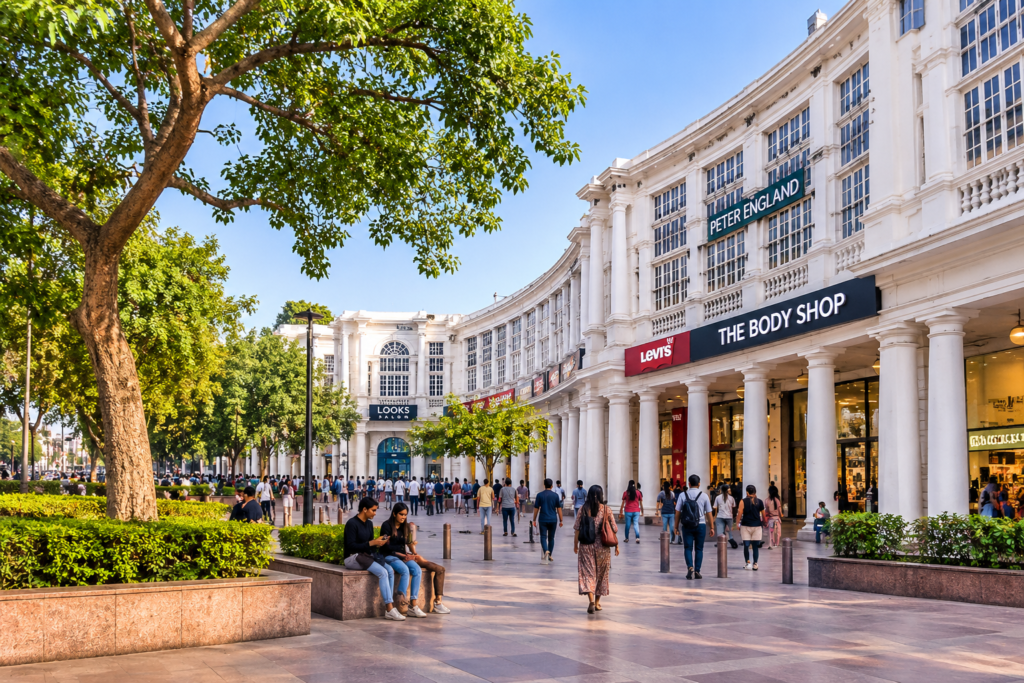
1. Central Park and the Inner Circle, for a slow start
Begin in the middle. Central Park sits inside the inner circle and has open lawns, an amphitheatre and a very large national flag. Locals use it as a break from shopping, so you will see office workers, students and families sitting on the grass. Walk a full loop of the colonnade first and look up at the old facades, because most people only look at the shop signs. Late afternoon is the nicest time, when the light turns soft and the heat drops.
2. Agrasen ki Baoli, for a hidden stepwell
Tucked between tall modern buildings off Hailey Road, this old stepwell comes as a real surprise. Its long flight of steps goes down in layers of stone arches, and the temperature drops as you descend. The stepwell is generally believed to date to the 14th century and is usually free to enter. Photographers love it in the late afternoon, when light falls on the lower arches. Expect pigeons and a slightly damp, earthy smell.
3. Jantar Mantar, for giant stone instruments
Built in 1724 by Maharaja Jai Singh II, Jantar Mantar is an open-air observatory with huge masonry instruments used to track the sun, moon and stars. The tall Samrat Yantra works like a giant sundial and is the one everybody remembers. Hire a guide or read the boards, because without an explanation the structures look like abstract sculptures. It is ticketed, so keep a little cash or UPI ready, and go in the morning, since the stone gets very hot by noon.
4. Gurudwara Bangla Sahib, for peace and langar
The golden dome and the sacred pool here make it one of the calmest places in central Delhi. Cover your head, remove your shoes and wash your feet at the entrance. Many visitors sit by the sarovar for a while and listen to the kirtan. The community kitchen serves simple langar meals to everyone who walks in, so you can eat here without spending anything. Evenings are especially atmospheric when the dome is lit up.
5. Janpath and Tibetan Market, for budget souvenirs
Janpath is the easiest place in the city to pick up gifts. Stalls sell handicraft items, silver-look jewellery, bags, scarves, wooden pieces and embroidered textiles. The Tibetan Market stretch has its own mix of jewellery, woollens and small decorative items. Prices are flexible, so compare a few stalls, bargain politely and settle somewhere in the middle. Carry small notes, because many stalls prefer cash.
6. Hanuman Mandir, for a quick local ritual
This busy temple on Baba Kharak Singh Marg is popular with office-goers who stop by on their way to work. Tuesdays and Saturdays draw the biggest crowds, so visit on another day if you want a quieter darshan. Shoes are kept at a counter, and offerings such as sindoor and flowers are sold outside. It takes only 20 to 30 minutes, which makes it easy to fit between other stops.