1. Majnu ka Tilla
Majnu ka Tilla, often called the Little Tibet of Delhi, is a Tibetan refugee settlement on the banks of the Yamuna. Narrow lanes are packed with small cafés, prayer-flag-covered rooftops and shops selling Tibetan jewellery, clothes and books. It is best known for momos, thukpa, laping and butter tea. The nearest metro station is Vidhan Sabha. Go in the afternoon for a relaxed walk and stay until evening when the lights come on. Many cafés are small, so be ready to wait for a table on weekends.
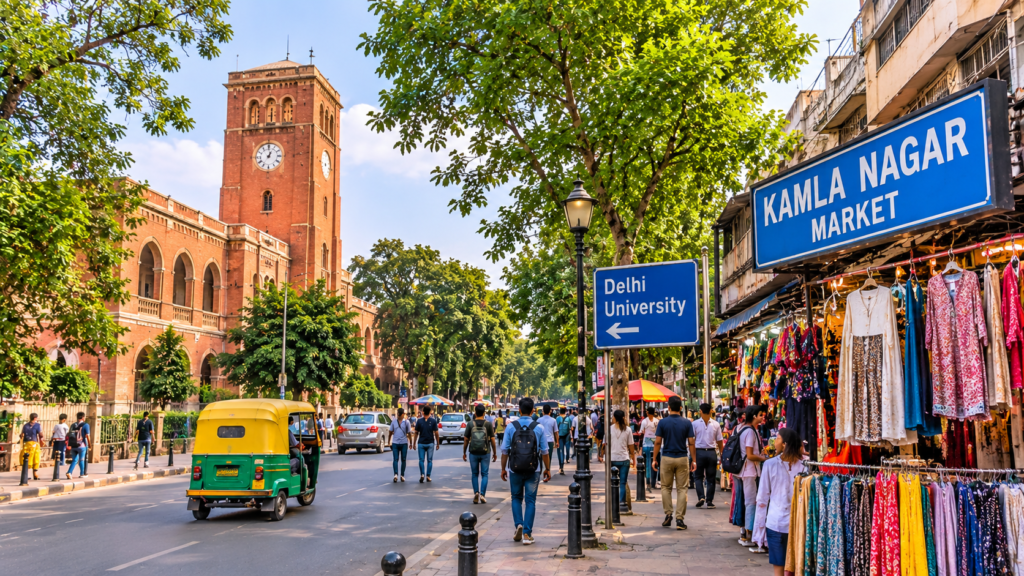
2. Kamla Nagar Market
Kamla Nagar is a busy market loved by Delhi University students and families alike. It is known for affordable clothes, footwear and accessories, along with a famous street food scene. You will find chaat, burgers, rolls, chole bhature and desserts within a short walk. The market gets very crowded in the evening, so visit around late afternoon if you want to browse comfortably. Bargaining works at open stalls but not at shops with fixed prices.
3. Delhi University North Campus
Even if you are not a student, the North Campus of Delhi University is worth a walk. Its stone colonnades and old college buildings reflect the early 20th-century style of the area. The campus surroundings are full of student life, with bookshops, photocopy shops and budget eateries. Check which areas are open to visitors, as some college campuses may restrict entry. Walking around the outer lanes is generally easy and gives a good sense of the neighbourhood.
4. Hudson Lane and Mukherjee Nagar
Near the university, Hudson Lane is a small stretch of cafés, bakeries and casual restaurants that students visit after class. It is a good option if you want a coffee, a sandwich or a dessert in a lively setting. A little further away, Mukherjee Nagar is famous for coaching institutes and the many affordable food stalls and tiffin services that serve students preparing for exams. The mood here is energetic and very local.
5. Flagstaff Tower
Flagstaff Tower on the Delhi Ridge is a round stone tower dating to 1828. During the Revolt of 1857, British women and children are said to have sheltered here before the tower was used as a signalling and meeting point. The tower is usually viewed from the outside, and the surrounding green area is quiet and good for a short walk. It is a good stop for history lovers who want to understand the 1857 story beyond textbooks.
6. St. James’ Church
Near Kashmere Gate, St. James’ Church was completed in 1836 and was built by Colonel James Skinner, a soldier of Anglo-Indian origin. Its yellow-and-white facade, central dome and cross-shaped plan make it one of the most distinctive churches in Delhi. It is an active place of worship, so dress modestly and keep your voice low. Visiting in the morning gives you the best light, and it pairs easily with Qudsia Bagh and the Kashmere Gate area.
7. Qudsia Bagh and Civil Lines
Qudsia Bagh was a garden built in the 1740s by Qudsia Begum, wife of Mughal emperor Muhammad Shah. Only parts of the original gateway and mosque now remain, but it is a peaceful corner of old Delhi history. Nearby Civil Lines was the British administrative centre after 1857, and it still has colonial bungalows, wide tree-lined roads and several important offices. A slow drive or walk here is a pleasant contrast to the crowded markets of the rest of the neighbourhood.